
"We're Not That Busy": Why Empty Service Bays Should Make Dealerships Rethink Automation
The cost of running automotive fixed operations, why customers are choosing independent repair shops, and how operational efficiency could help dealerships become more competitive.
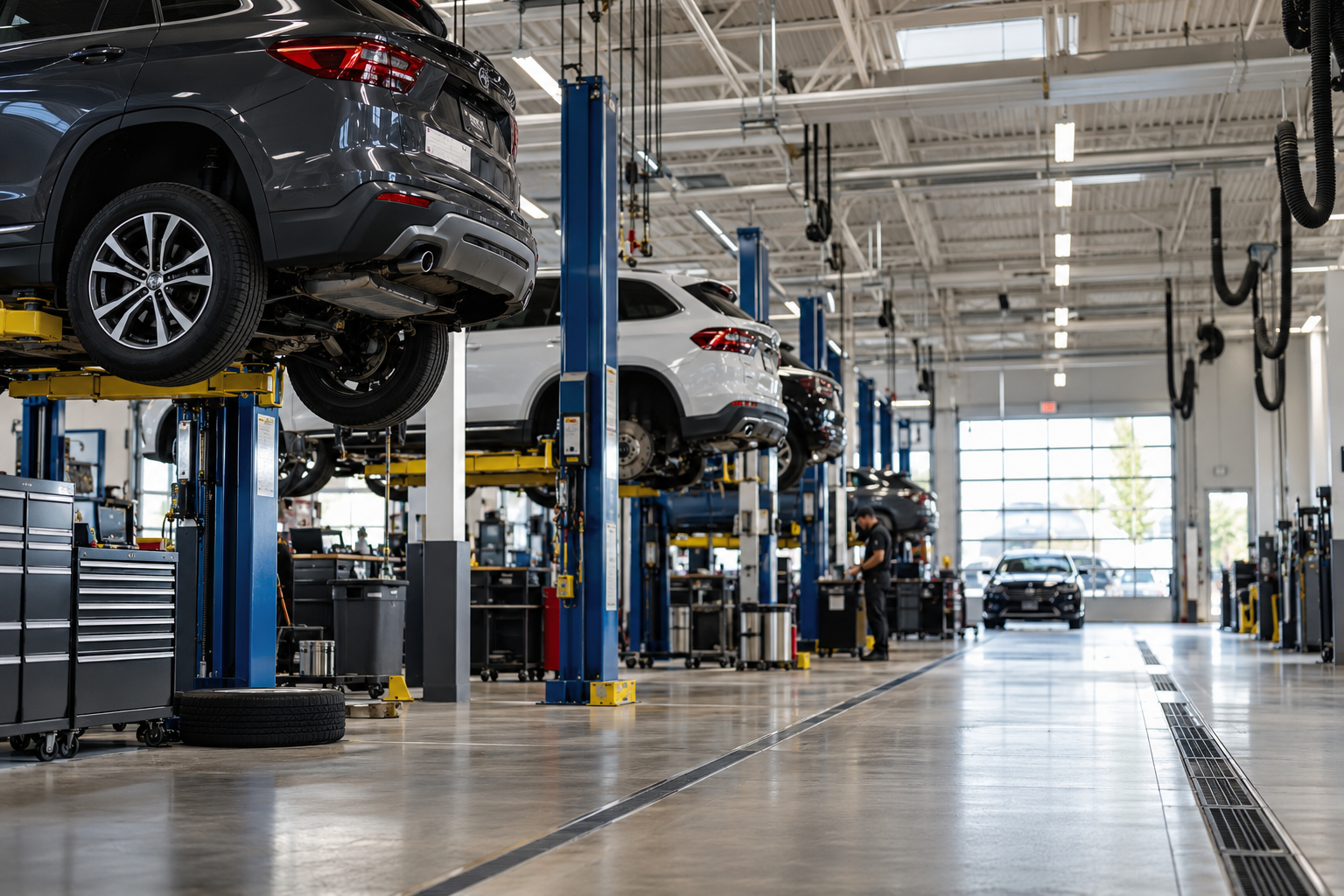
Why rising maintenance costs, underutilized service departments, and operational inefficiency should have dealerships rethinking how they do business.
Yesterday, I spoke with a service manager at a car dealership about implementing automation.
His response concerned me more than anything.
"We're not that busy."
He explained that the dealership had plenty of service bays, but many weren't being utilized.
THAT'S EXACTLY WHY I CALLED.
We've developed this perception that automation is something businesses implement when they're overwhelmed.
Too many orders. Not enough employees. More work than they can handle.
But what happens when a business isn't busy?
What happens when its service bays sit empty, expensive equipment goes unused, and the cost of running the facility keeps climbing?
More importantly, what happens when those operating costs contribute to service prices that customers increasingly struggle to afford?
That's the conversation I think the automotive industry needs to have.
1. The Automotive Service Market Isn't Shrinking. So Why Are Some Bays Empty?
Canadians aren't suddenly driving vehicles that don't require maintenance.
Quite the opposite.
According to J.D. Power's 2025 Canada Customer Service Index—Long-Term Study, the Canadian automotive service market reached an estimated $18.8 billion.
With new vehicles becoming increasingly expensive, Canadians are keeping their existing vehicles longer, contributing to continued demand for maintenance and repairs.
The same study found:
- Dealership service visits averaged $539, up from $465 in 2024.
- Aftermarket service visits averaged $302.
- 65% of surveyed customers choosing aftermarket service cited dealership costs as their primary reason.
That's nearly 80% more spent per visit at dealerships, although the difference also reflects the types of repairs performed.
Dealerships still capture approximately 48% of service visits and 62% of automotive service revenue in Canada.
So the market is there.
Customers are spending money.
Vehicles still need repairs.
Yet some dealerships have service bays sitting empty.
Perhaps the problem isn't simply a lack of demand. Perhaps it's a question of competitiveness.
If customers believe they can get comparable routine maintenance at an independent repair shop for less, why would they automatically choose the dealership?
Dealerships have real advantages: manufacturer-trained technicians, specialized diagnostic equipment, genuine parts, and expertise in complex repairs.
Those advantages matter.
But so does affordability.
Customers shouldn't have to choose between trusted, professional service and a price they can reasonably afford.
2. What Does It Actually Cost to Run Fixed Operations?
Before criticizing dealership pricing, it's important to acknowledge something.
Running a service department is expensive.
A dealership isn't simply paying a mechanic to repair a vehicle.
It's supporting an entire operation.
Technicians and apprentices. Service advisors. Parts personnel. Managers. Administrative staff. Expensive diagnostic equipment. Vehicle lifts. Training. Inventory. Utilities. Insurance. Property costs. Software systems.
Every service department needs enough revenue and gross profit to cover its operating expenses while generating an acceptable return.
Consider a simplified customer invoice:
- Labour: 1.5 hours at $170/hour = $255
- Parts and consumables = $135
- Shop supplies = $15
- Subtotal = $405
- Ontario HST = $52.65
- Customer total = $457.65
This is an illustrative invoice, not the average price of a particular maintenance service.
The $170 labour rate is also not what the technician earns.
In fact, 2026 Canadian dealership data reported by Reynolds and Reynolds showed an average effective customer-pay labour rate of approximately $163.82 in large population centres.
The effective labour rate represents actual labour revenue per billed hour. That revenue must contribute toward technician compensation, support costs, operating expenses, and profit.
Here's where things get interesting.
The cost of running a service department doesn't decrease proportionately when the number of customers falls.
The building still needs heating.
The equipment still needs maintaining.
The insurance still needs paying.
Much of the staffing and infrastructure remains in place.
And those costs now have to be recovered across fewer revenue-generating service hours.
This is why productivity and utilization matter so much.
3. The Hidden Cost of Empty Service Bays
Imagine a dealership service department with $60,000 in monthly fixed overhead.
For this example, assume:
- Effective labour rate: $170 per billed hour.
- Direct variable cost: $55 per billed hour.
- Monthly fixed overhead: $60,000.
Now compare three levels of billed labour activity.
Low Utilization — 300 Billed Hours
- Labour revenue: $51,000
- Total modeled operating costs: $76,500
- Operating loss: $25,500
- Fixed overhead per billed hour: $200
Medium Utilization — 600 Billed Hours
- Labour revenue: $102,000
- Total modeled operating costs: $93,000
- Operating profit: $9,000
- Fixed overhead per billed hour: $100
High Utilization — 900 Billed Hours
- Labour revenue: $153,000
- Total modeled operating costs: $109,500
- Operating profit: $43,500
- Fixed overhead per billed hour: approximately $67
These are illustrative results from a simplified labour-only financial model. They are not industry profit benchmarks and exclude parts economics and other dealership activities.
Calculate the True Cost of Your Empty Service Bays
Every dealership has a different cost structure. Understanding how operating costs, billed hours, and utilization affect profitability is the first step toward identifying opportunities for improvement.
We've developed a free, interactive Fixed Operations Profitability Calculator to help dealership owners, general managers, and fixed operations directors evaluate their service department economics.
Adjust your monthly overhead, effective labour rate, variable costs, and billed hours to compare low, medium, and high utilization scenarios.
See how improvements in productivity can reduce overhead per billed hour, improve operating margins, and change your break-even point.
Try Our Free Fixed Operations Profitability Calculator
Explore different scenarios using your own operating assumptions to better understand the financial impact of underutilized service capacity.
What the Numbers Reveal
Notice something important: The labour rate never changes.
At 300 billed hours, the service operation is losing money under these assumptions.
At 600 hours, it's profitable.
At 900 hours, the same fixed-cost structure supports substantially more operating profit.
The difference isn't higher service pricing.
It's the ability to generate more productive, billable work using the resources already available.
This is also related to an important dealership financial metric called fixed absorption: how effectively the gross profit from service, parts, and related fixed operations covers dealership overhead.
A healthy fixed operations department can help support the financial stability of the entire dealership, particularly when vehicle sales fluctuate.
Of course, increasing billed hours requires enough customer demand, technicians, and physical capacity. Improving efficiency doesn't automatically create additional repair orders.
But the example demonstrates the importance of understanding where operating costs are being absorbed and where capacity is being wasted.
Before raising service prices, shouldn't we first understand whether we are operating as efficiently as possible?
4. Your Technicians Are Busy. But Are They Productive?
Let's look beyond the financial statements and into the service department itself.
A highly skilled automotive technician should be diagnosing vehicles, performing maintenance, and completing repairs.
But how much of their day is spent doing something else?
Walking to the parts counter.
Waiting for a component.
Transporting batteries, wheels, tires, or equipment.
Searching for tools.
Moving materials between workstations.
Coordinating with other departments.
These activities might be necessary, but they don't always require the skills of a trained automotive technician.
And they can interrupt valuable repair work.
Being occupied for eight hours is not the same as generating eight hours of productive value.
A technician who repeatedly leaves their workstation to collect parts is not necessarily working inefficiently.
They may simply be operating within an inefficient system.
That's an important distinction.
The problem isn't always the employee. Sometimes it's the workflow we've designed around them.
The Hidden Cost of Breaking a Technician's Focus
There's another cost that rarely appears on a service department's financial statements: the cost of interrupted concentration.
Imagine a technician diagnosing an intermittent electrical fault.
They're reviewing diagnostic codes, testing circuits, interpreting measurements, and narrowing down potential causes.
Then they need a component from the parts department.
They stop what they're doing, walk across the facility, collect the part, and return.
The trip takes five minutes.
But did that interruption really cost only five minutes?
When the technician returns, they may need to review their previous findings, remember which tests they've completed, and mentally reconstruct where they left off.
Researchers call this task resumption lag: the additional time required to resume an interrupted activity.
Studies of workplace interruptions have shown that disruptions can increase task completion time and the likelihood of errors, particularly when people are performing cognitively demanding work.
There isn't a universal multiplier that turns a five-minute interruption into a specific amount of lost productivity. The impact depends on the complexity of the task, the timing of the interruption, and what the employee needs to remember when returning.
But the underlying principle is important.
A five-minute parts run can cost more than five minutes of productivity.
For technicians performing complex diagnostics, maintaining concentration can be just as important as having the right equipment.
And when these interruptions happen repeatedly across multiple technicians throughout the day, the cumulative impact can become significant.
Consider the downstream effects:
- Longer diagnostic and repair times.
- Additional time spent reviewing previous work.
- Increased opportunities for mistakes or missed steps.
- Delayed completion of service orders.
- Reduced capacity to handle additional customer appointments.
This is why improving material delivery isn't simply about eliminating walking time.
It's about protecting skilled workers' attention and allowing them to complete demanding tasks with fewer unnecessary interruptions.
Measure the Work That Doesn't Add Value
Dealerships should be measuring more than how many technicians they employ or how many service bays they have available.
They should be asking:
How much time is lost to unnecessary movement?
How often are technicians interrupted during repairs?
How much time is spent waiting for parts, equipment, or instructions?
How much of a technician's paid time is converted into productive, billable service?
And how much of that lost time could be recovered through better processes, coordination, or automation?
The objective shouldn't be to make technicians work harder. It should be to eliminate the unnecessary work that prevents them from doing their jobs.
Because improving productivity isn't just about completing more repair orders.
It's about creating an environment where technicians can focus on the work they're trained to do, customers receive their vehicles sooner, and dealerships get more value from the resources they already have.
4. Your Technicians Are Busy. But Are They Productive?
Let's look beyond the financial statements and into the service department itself.
A highly skilled automotive technician should be diagnosing vehicles, performing maintenance, and completing repairs.
But how much of their day is spent doing something else?
Walking to the parts counter.
Waiting for a component.
Transporting batteries, wheels, tires, or equipment.
Searching for tools.
Moving materials between workstations.
Coordinating with other departments.
These activities might be necessary, but they don't always require the skills of a trained automotive technician.
And they can interrupt valuable repair work.
Being occupied for eight hours is not the same as generating eight hours of productive value.
A technician who repeatedly leaves their workstation to collect parts is not necessarily working inefficiently.
They may simply be operating within an inefficient system.
That's an important distinction.
The problem isn't always the employee.
Sometimes it's the workflow we've designed around them.
Dealerships should be measuring more than how many technicians they employ or how many bays they have available.
They should be asking how much time is lost to unnecessary movement, delays, waiting, poor coordination, and interruptions.
Then they should determine which activities can be eliminated, reorganized, delegated, or automated.
5. How Much Is 15 Minutes of Wasted Time Actually Worth?
Consider a service department with ten technicians.
If each technician spends just 15 minutes per day on repetitive material movement that could be eliminated, what does that represent?
Across 22 working days:
10 technicians × 15 minutes × 22 days = 55 hours of recoverable technician capacity per month.
Now suppose the dealership can convert 60% of that recovered capacity into additional billed service work.
That's 33 additional billed hours.
At an effective labour rate of $170 per hour:
33 hours × $170 = $5,610 in potential additional monthly labour revenue.
Over twelve months, that's $67,320 in potential additional labour revenue.
Not profit. Revenue.
Additional labour costs, automation costs, implementation expenses, and other operational considerations still need to be accounted for.
And there's a crucial condition: the dealership must have enough customer work available to convert recovered capacity into additional billed hours.
If there isn't sufficient demand, the dealership should evaluate savings through reduced overtime, better staffing utilization, faster turnaround, improved service consistency, or other measurable benefits.
But the example illustrates something important.
Small inefficiencies become expensive when they're repeated across an entire operation, every day.
And eliminating those inefficiencies doesn't necessarily require hiring more people or expanding the facility.
6. Automation Isn't About Replacing Mechanics. It's About Removing Unnecessary Work.
This is where automation enters the conversation.
At Reliable Robots, we look at the repetitive tasks that consume employee time without making the best use of their skills.
In a dealership service department, autonomous mobile robots can support the transportation of parts, batteries, tires, tools, and other materials between designated locations.
Rather than having technicians repeatedly leave their workstations, material delivery can become a more coordinated part of the workflow.
Of course, deploying a robot alone doesn't fix inefficient operations.
Parts need to be available.
Requests need to be coordinated.
The robot needs to fit the facility, traffic patterns, and material-handling requirements.
And the business needs a realistic understanding of what it hopes to improve.
Sometimes the best solution is automation.
Sometimes it's better scheduling, inventory management, or process redesign.
Often it's a combination.
The goal isn't to automate everything. It's to stop paying skilled people to perform work that doesn't require their skills.
7. What If Operational Savings Made Dealership Service More Affordable?
This brings us back to the customer.
Why are so many vehicle owners choosing independent repair shops?
Price is a major reason.
And while dealerships have higher operating requirements in some areas, they also have opportunities to improve efficiency.
Imagine a service department that reduces wasted technician movement, improves parts availability, increases productive work time, and recovers more value from its existing facility.
The dealership now has options.
It can protect its margins without relying exclusively on increasing service rates.
It can introduce more competitive routine maintenance pricing.
It can improve customer turnaround times.
It can invest in better service experiences.
And it may be able to attract customers who previously assumed dealership maintenance was simply too expensive.
Not every efficiency improvement should translate directly into a lower customer invoice. Dealerships still need healthy margins to remain sustainable.
But some of those savings could be used to strengthen customer value and retention.
That creates the possibility of a reinforcing cycle:
Lower operating cost per service. More competitive pricing. Better customer retention. More consistent service volume. Stronger overhead recovery.
That's a much more interesting long-term strategy than simply increasing labour rates to compensate for operational inefficiency.
8. "We're Not That Busy."
I've thought about that response since our conversation.
I wasn't calling because I thought his technicians were overwhelmed.
I was calling because I believe there are better ways to operate a service department.
Better ways to utilize skilled labour.
Better ways to move materials and coordinate work.
Better ways to control operating costs without compromising service quality.
And ultimately, better ways to make dealership service competitive again.
Automation isn't always the answer.
But dismissing operational improvement because business is slow misses the point.
You don't have to be busy to need efficiency.
Sometimes you need efficiency to become competitive enough to get busy.
About Reliable Robots
Reliable Robots helps businesses improve productivity through autonomous cleaning, material transport, and industrial automation solutions.
For automotive dealerships, we explore opportunities to reduce repetitive parts movement, improve shop logistics, and allow skilled technicians to spend more time on the work they're trained to perform.
Letting people focus on people.
Learn more at www.reliablerobots.ca.